On Friday (10 April) the four of us travelled to Margaret River for the long Easter weekend. Margaret River is about 100 miles south of Perth and is the city at the center of the wine area of South west Australia. It was very busy since it was the beginning of the spring holiday for the local school children. Margaret River boasts more than 100 wineries where most of the popular wines get exported from, particularly white wines that are exceptional in the region. We visited 6 wineries and 2 breweries over the extended weekend. 


 We stayed in a wonderful little two bedroom apartment that had full kitchen and two baths.
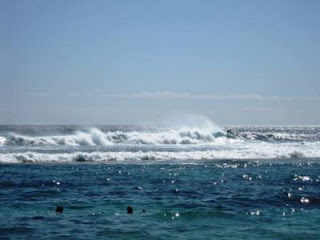
 More often than not we ended up having a large lunch somewhere then staying in for the evening, content with fine wines, cheeses, meats and conversation. Besides the wineries, we explored the coastlines of the Indian Ocean which had spectacular views. We stopped along the coast for a picture or two. Our favorite part was watching serious surfers riding serious waves.

 Our final stop was to the Leeuwin Point lighthouse.
 On the way back to Freemantle, we passed through some wildfire areas 40 km south of Freemantle. They were mostly under control, but you could still see some hotspots and we could smell the fire in the mornings from our bedroom. Hundreds of acres burned, but luckily they were able to keep it from jumping the highway to nearby houses. It is so sad - it was arson and it was devastating.
Tuesday was a stay-in day so we could catch up on laundry and replenishing supplies for the rest of the week and for our onward travels. That evening we enjoyed dinner at Ruocco’s, a nearby Italian restaurant. After hearing about them and seeing them for nearly two weeks, Tom indulged in a grilled crayfish. This was not the little freshwater creatures found in Michigan streams. Crayfish means Australian Rock Lobster, pretty much like the lobsters available in Maine, but without the large claws. On Wednesday morning we headed with Max to the downtown Perth area. Our first stop was the Swan River estuary and a delightful tour of it provided by Vicci’s father, in a wooden speed boat he had built himself, named Rascal, and the second of the three in his homemade fleet.

 Patti had the special privilege of steering the boat while Mr. Niven kept control of the throttle, primarily to assure that the boat didn’t go too slow. Our next stop was King’s Park
 which overlooks the Swan River estuary and the Perth City center.

 We walked the trails, enjoying the trees and flowers. Part of one trail is elevated, so that we walked between the trees at the canopy level, the better to see the leaves. At that point we parted company with Max and headed for the Museum of Western Australia.
Tom discovered a new obsession when we were in Denham at the Shark Bay Discovery Center: the Dirk Hartog plate. Hartog was a Dutch merchant sea captain who made landfall on the west coast of Australia in 1616. To record the event, he had a pewter plate hammered flat, inscribed on it the date and a few names, and nailed it to a post on the near shore island now named for him. Nine years later another Dutch merchant captain, Vlemingh, found the plate. He hammered out a new pewter plate from ship's stores, copied Hartog's inscription on it, then added his own. Vlemingh took the original Hartog plate with him, and it ended up in Amsterdam. Almost 200 years later a French expedition picked up Vlemingh's plate and took it back to Paris. The Discovery Center in Shark Bay said that the original Vlemingh plate had been returned to Australia in 1947, and that it resided in the Western Australia Museum. We didn't find it there. The museum staff said it was in the maritime museum.
 We didn't find it there, but we did find the next clue: the shipwreck museum down the street.
 We finally tracked down Vlemingh's original plate,
 and now Tom is aiming for Hartog's in Amsterdam.
Anyway, after visiting the museums, we walked along the harbor back towards Max and Vicci's house and stopped in at a delightful brewpub called Little Creatures. We had "chips" (fries)with garlic mayo sauce and Portugese sausage, and of course their house brews. Thus fortified, we returned to the house to finish packing. Following a simple pizza dinner, we said our goodbyes, not eager to leave because we had such fun with Vicci and Max in Western Australia.
We stayed in a wonderful little two bedroom apartment that had full kitchen and two baths. More often than not we ended up having a large lunch somewhere then staying in for the evening, content with fine wines, cheeses, meats and conversation. Besides the wineries, we explored the coastlines of the Indian Ocean which had spectacular views. We stopped along the coast for a picture or two. Our favorite part was watching serious surfers riding serious waves. Our final stop was to the Leeuwin Point lighthouse.On the way back to Freemantle, we passed through some wildfire areas 40 km south of Freemantle. They were mostly under control, but you could still see some hotspots and we could smell the fire in the mornings from our bedroom. Hundreds of acres burned, but luckily they were able to keep it from jumping the highway to nearby houses. It is so sad - it was arson and it was devastating.Tuesday was a stay-in day so we could catch up on laundry and replenishing supplies for the rest of the week and for our onward travels. That evening we enjoyed dinner at Ruocco’s, a nearby Italian restaurant. After hearing about them and seeing them for nearly two weeks, Tom indulged in a grilled crayfish. This was not the little freshwater creatures found in Michigan streams. Crayfish means Australian Rock Lobster, pretty much like the lobsters available in Maine, but without the large claws.
On Wednesday morning we headed with Max to the downtown Perth area. Our first stop was the Swan River estuary and a delightful tour of it provided by Vicci’s father, in a wooden speed boat he had built himself, named Rascal, and the second of the three in his homemade fleet. Patti had the special privilege of steering the boat while Mr. Niven kept control of the throttle, primarily to assure that the boat didn’t go too slow. Our next stop was King’s Park which overlooks the Swan River estuary and the Perth City center. We walked the trails, enjoying the trees and flowers. Part of one trail is elevated, so that we walked between the trees at the canopy level, the better to see the leaves. At that point we parted company with Max and headed for the Museum of Western Australia.Tom discovered a new obsession when we were in Denham at the Shark Bay Discovery Center: the Dirk Hartog plate. Hartog was a Dutch merchant sea captain who made landfall on the west coast of Australia in 1616. To record the event, he had a pewter plate hammered flat, inscribed on it the date and a few names, and nailed it to a post on the near shore island now named for him. Nine years later another Dutch merchant captain, Vlemingh, found the plate. He hammered out a new pewter plate from ship's stores, copied Hartog's inscription on it, then added his own. Vlemingh took the original Hartog plate with him, and it ended up in Amsterdam. Almost 200 years later a French expedition picked up Vlemingh's plate and took it back to Paris. The Discovery Center in Shark Bay said that the original Vlemingh plate had been returned to Australia in 1947, and that it resided in the Western Australia Museum. We didn't find it there. The museum staff said it was in the maritime museum.
We didn't find it there, but we did find the next clue: the shipwreck museum down the street. We finally tracked down Vlemingh's original plate, and now Tom is aiming for Hartog's in Amsterdam.Anyway, after visiting the museums, we walked along the harbor back towards Max and Vicci's house and stopped in at a delightful brewpub called Little Creatures.
We had "chips" (fries)with garlic mayo sauce and Portugese sausage, and of course their house brews. Thus fortified, we returned to the house to finish packing. Following a simple pizza dinner, we said our goodbyes, not eager to leave because we had such fun with Vicci and Max in Western Australia. 
 were kind enough to pick us up from the airport, and kinder still to offer us the hospitality of their home in Fremantle. We enjoyed their company and a great meal from the barbie while watching the sunset over the Indian Ocean—all from the back deck of their home. Vicci and Max made us feel very much at home and it was delightful to stay with them.


 We felt a bit ridiculous at first

 We had a delightful dinner of local sea food and watched a breathtaking sunset.

 From the boat we saw more dolphins,

 which is a century-old former Anglican rectory, charmingly restored to its original period. Here is the foyer, complete with church pew.
 On Thursday we enjoyed another fine evening with Vicci and Max. We grew particularly fond of the hammock!


 and Tom was especially happy that he could be observing instead of concentrating on driving.
 On the way, we had a number of adventures from a traffic jam of sheep

 to a small bus crossing the white line on a curvy mountain road and sideswiping our bus, leaving the driver’s mirror missing and a huge pane of shattered glass. We had to pull over so the driver could punch out the pane before it splintered into his lap. He never missed a beat in the tour discourse as he continued with the history and high points of Milford Sound.

 It is a deep, icy blue waterway flowing into the Tasman Sea and is part of the majestic Fiordland National Park.
 Carved over time by glaciers the deepest part of the Fiord is 400 metres, and the actual length of the Fiord is 16km from St Annes Point.


 is the latest addition to the Milford Sound Red Boat fleet, and is a catamaran designed with extensive viewing decks where we could enjoy the magnificent scenery in relaxation and comfort. The flat bow design enabled us to get up close to nature and the large panoramic windows ensured unobstructed views of the Fiord. It was in a word spectacular!

 Queenstown is an international resort town in Otago in the south-west of New Zealand's South Island. It is built around an inlet on Lake Wakatipu, a long thin lake formed by glacial processes that is shaped like a staggered lightning bolt, and has spectacular views of nearby mountains. We thought of Matt when we saw that for no particular reason, there was a bungee jumping gnome hanging in the corner of the vintners lobby. Bring back memories of Hope, Matt?

 Principal photography for all three films was conducted concurrently in many locations within New Zealand's conservation areas and national parks between 11 October 1999, and 22 December 2000.
 Billed as the first commercial bungee site in the world, it is 23km outside of Queenstown. The Kawarau Bridge Bungee is situated on the main road between Queenstown and Cromwell, near the Nevis Bluff and the Gibbston Valley. The bridge platform is 43 metres above the Kawarau River and the jumper has the option of a head and shoulders splashdown in the river if he/she feels like cooling off.
 we saw some truly stunning landscapes
 and observed Mt. Cook.
 New Zealand's highest peak was named Mt Cook (after the British explorer Captain James Cook) by Captain Stokes of the survey ship HMS Acheron. Mt Cook sits at the heart of New Zealand’s Alpine country, within the 700 square kilometres of Mt Cook national park, and is almost equidistant from Christchurch and Queenstown. At 3764 metres, it is the highest of the country's 27 mountains over 3000 metres. It is called Aoraki (or Aorangi, ao meaning land, rangi meaning sky or heavens) by the Maori.

 And just to be politically correct and open minded, the Druid Center and local Lodge were directly across the street.


 But mostly, she was a polar widow and found other interesting displays in the Canterbury Museum to explore. These included such things as the reproduction of the tent in which the first surgeon of Christchurch lived and worked with his wife and 8 children for two years before a house could be built, and skeletons of the three species of moa that inhabited New Zealand until about 500 years ago. A relative of the ostrich, emu, rea, and cassuarie, the largest moa topped out at around 8 feet. It is generally accepted that the moa were hunted to extinction by the early Maori settlers.

 This garden was created deliberately to foot a planthold from the Mother Country, England. Why else have a Rock and Heather section? It is beautiful and it’s easy to understand why so many were enjoying their strolls under a cloudless autumn sky. Of course, Tom's favorite spot in the park was at the statue of Scott, whom he had just spent hours studying in the museum.

 The ferry Kaitaki was enormous—10 decks and capacity for nearly a thousand passengers, plus vehicles. The crossing of Cook Strait to Queen Charlotte Sound, Shakespeare Bay, and the port of Picton took about 3 hours. We spent almost that entire time on the open deck 10 so we could enjoy the scenery. Once we entered the Cook Strait the wind drove the more rational passengers below. We took a few short breaks from the wind, but no apologies for our choice. It was a very pleasant ride despite the wind, and a highly detailed map of the passage was mounted outside so we could watch for the landforms.
 After disembarking in Picton we made our way to the train station.


 For a brief section we skirted evaporation ponds for the production of sea salt. Several of these had a magenta coloring which the conductor announced was due to the same algae which give the Red Sea its color.
